University of Portland had participated in SAE Aero for years, but mostly through capstone teams, which meant club involvement was limited and knowledge often failed to carry forward from one season to the next. In the 2025 season, we reorganized that structure so the student club would take on the Micro Class competition while the capstone prepared for Advanced Class, with the goal of developing earlier technical experience and stronger year-to-year knowledge transfer, creating a stronger pipeline of experience, leadership, and continuity. The Micro Class competition required carrying as much onboard water payload as possible while minimizing wingspan and takeoff distance under a 450 W power limit, which drove us toward a low aspect ratio flying-wing design and a development process that could iterate quickly and learn from testing.
My role was both technical development and club management. On the aircraft side, I led propulsion selection and electronics, including sensors, flight controller programming and tuning, wiring, and more. I introduced a foamboard prototyping workflow that combined traditional hobby techniques with CAD modeling that let us begin meaningful flight testing early, and supported design decisions with onboard instrumentation and performance data. At the same time, I took on much of the background work to help re-establish the club as a functioning engineering team, which included fundraising, budgeting, scheduling, and creating systems that made it easier for newer members to contribute and learn.
This project reinforced that strong engineering outcomes usually come from implementation, not just strong ideas. Rapid prototyping and intentional early flight testing let us identify problems quickly, compare predictions against measured performance, and make better decisions before committing to the final airframe. At the same time, the organizational systems we built (budgeting, documentation, and mentoring newer members) gave the project value beyond a single competition season. Placing 2nd reminded us that you don’t need a legacy team to perform well, and also served as motivation for the next season’s team. Ultimately, seeing the 2026 Micro Class team hit the ground running was the most rewarding thing for me - our goal was not only to place well, but to start a legacy at UP, and I’m thrilled to see the beginnings of it!
Skills used/demonstrated
Conceptual aircraft design, trade studies, electronics system design & implementation, rapid prototyping, flight-test planning, instrumentation, data-driven design iteration, budgeting and procurement, project coordination, team leadership, documentation, mentorship.
Below you can find a more detailed version of the above!
Context
University of Portland had been participating in the Regular Class part of SAE Aero Design for decades, but primarily as a Capstone project, with assistance from club members. After seeing low club involvement and how knowledge failed to transfer between years, one of the club members invited me to co-lead the club with him, switching things up a bit. Instead of assisting the capstone, the club would participate in the competition by themselves, with the capstone preparing for Advanced class. This would allow underclassmen to start building their knowledge early, and hopefully provide a path for the club and capstone to grow into the future.
For the 2025 SAE Aero Design Micro Class competition, teams were tasked with carrying as much onboard water payload as possible while minimizing wingspan and takeoff distance and constrained to a 450w power budget. Our team chose a flying-wing configuration to maximize lifting area per unit wingspan. The aircraft needed to be light, efficient, stable, and capable of handling a shifting water payload in flight.
At the same time, we needed to iterate quickly. Building each revision out of balsa and carbon fiber would have made that process far too slow, expensive, and fragile, especially early on when crashes and major redesigns were still likely. A big part of my role became managing our testing and prototyping, as well as speccing and configuring our electronics. Not only that, but helping to manage what was effectively the re-founding of a club: managing finances, scheduling, project management, and more.
Key Contributions
I designed the propulsion system by comparing single and dual-motor configurations within our weight limits. The final design used two SunnySky X2212 V3 980 Kv motors with APC 9x4.7 propellers, producing 4.8 lb of combined static thrust while remaining efficient enough for the aircraft’s cruise and takeoff requirements. This was a minor benefit over a single-motor design, as it was slightly lighter and increased blown lift over the wings.
I also developed the team’s foamboard prototyping workflow. While uncommon in SAE Aero, it allowed us to begin meaningful flight testing early and catch design issues before investing time in the final balsa and carbon fiber airframe. Although the foamboard prototypes were heavier, they flew without water payload, so their all-up weights and handling characteristics remained comparable to the final aircraft.
Prototype V1, Partially Constructed
Prototype V1, post-crash
Prototype V2 CAD
Prototype V2
Throughout the project, I also led flight testing and instrumentation. Prototype aircraft logged airspeed, GPS, and power data, allowing us to compare predicted and measured performance and make design changes based on real results rather than pilot feel alone. This testing directly informed later revisions, including a roughly 50% reduction in the first prototype’s oversized control surfaces.
Prototype V2 Executing a Loop Maneuver
Examples of flight footage used for handling quality assessments. Left, takeoff; Right, 90-degree bank. “Quadcopter” view is an iNav issue.
On the club-founding side of things, I found myself in over my head at first. But we gained consistent members and eventually founded a core team, and decided one of the best ways to kickstart the club would be to perform well at competition, document our processes, mentor for future teams, and bring underclassmen through not only the design journey but the competition experience. I also managed the majority of the purchasing and budgeting, which included tracking receipts and reimbursements.
[club picture]
Final Design
The final aircraft had a 30.125 in wingspan, a 720 in^2 wing area, and an empty weight of 2.3 lb including batteries. At a maximum takeoff weight of 4.1 lb, it carried up to 1.8 lb of water payload, about 44% of total takeoff mass.
Competition Results
Category
Placement
Score
Mission (Flight)
3rd
48.91
Presentation
3rd
38.27
Report
6th
40.67
Overall
⭐ 2nd ⭐
127.85
Out of 22 teams, we placed 2nd overall, with 3rd-place finishes in both flight performance and presentation. More importantly to me, the airplane ended up being predictable, efficient, and genuinely pleasant to fly - our competition-provided pilot described our aircraft as "one of the most enjoyable to fly … it handled beautifully." Our report, our lowest score, was primarily docked for a minor formatting issue that propagated, rather than a technical error. While this was unfortunate, it was a minute difference versus the teams above us, and ultimately would not impact our overall standing.
Conclusions
To say the team was thrilled with our score would be an understatement. Working with such a great team and building the club from the ground up was an incredible experience.
This project reinforced how valuable rapid iteration can be dealing with a brand-new problem, and taught me skills for managing diverse teams with varying levels of expertise and interest. It was also a reminder that a lot of good design work is really about building a process that helps the team make better decisions, and documenting those workflows for future use. For us, the real progress came from treating prototyping and flight testing as core parts of the design itself, rather than something to do after a design is finished.
While only one underclassmen joined us for the competition, he has now gone on to co-lead the next year of the club. The entirety of the core team, plus a couple additions, have moved on to the Advanced Class Capstone, as planned, and we are progressing steadily (more info to come there eventually). We continue to mentor the club team (while allowing them to progress on their own), and are creating resources for future clubs and capstones to reference regarding how to get started, how to run a club, and all of the other things we’ve learned along the way. The club team will be joining us at competition this year, hopefully paving the way for a new beginning for the SAE Aero teams at University of Portland.
Max, now 2026 club leadership.
Our first flight, a success! (Shiley School of Engineering @ University of Portland)
Our competition plane, Lou, dedicated to the retiring Dr. Lulay, a legend in the UP engineering department.
Our backup plane, Murt, dedicated to Dr. Murty, another retiring professor who had taught at UP so long that Dr. Lulay was one of his students.
Skyler, Zach & Chase (left→right) chatting with competition officials.
Our test plane, Bart, dedicated to one of our retiring professors, Dr. Farina. When I asked him if he wanted his name on one of our planes, he chuckled and said “only if it crashes and burns.” Naturally, he got to be on the foamie.
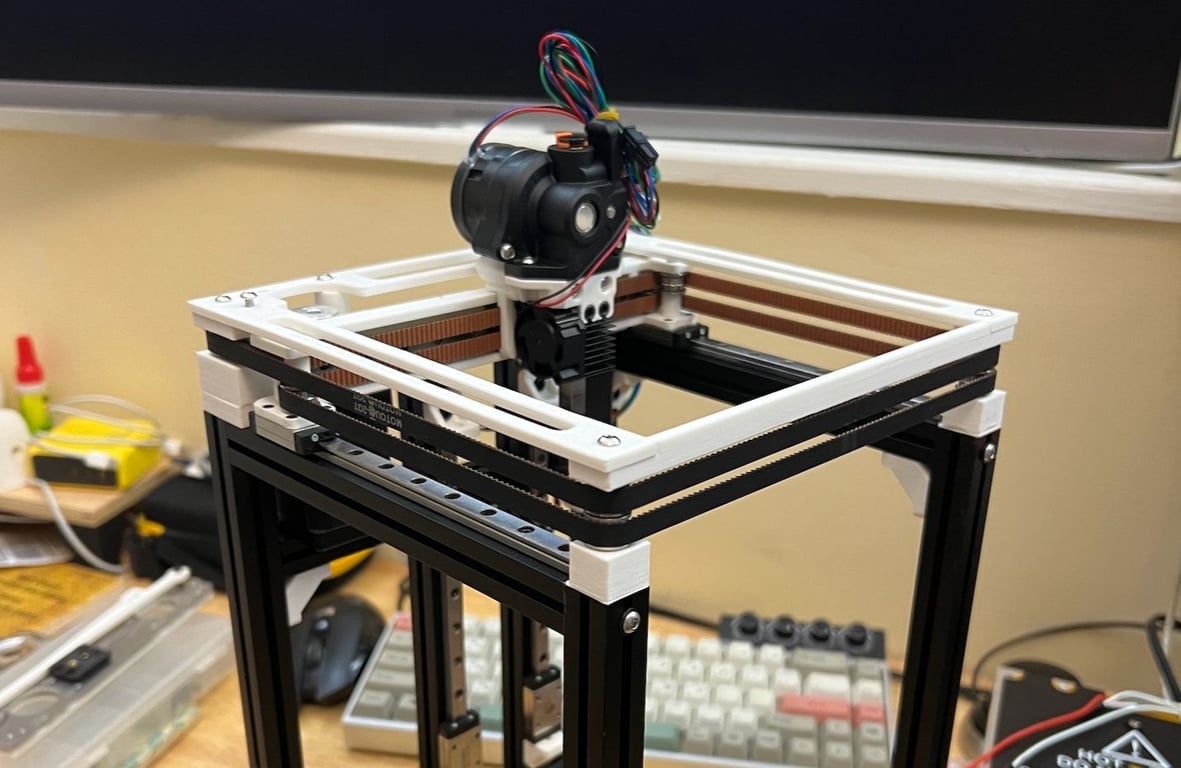
An ultra-compact CoreXY 3D printer design with a 35% smaller footprint and 50% smaller overall volume than the Voron V0 with the same usable print size